
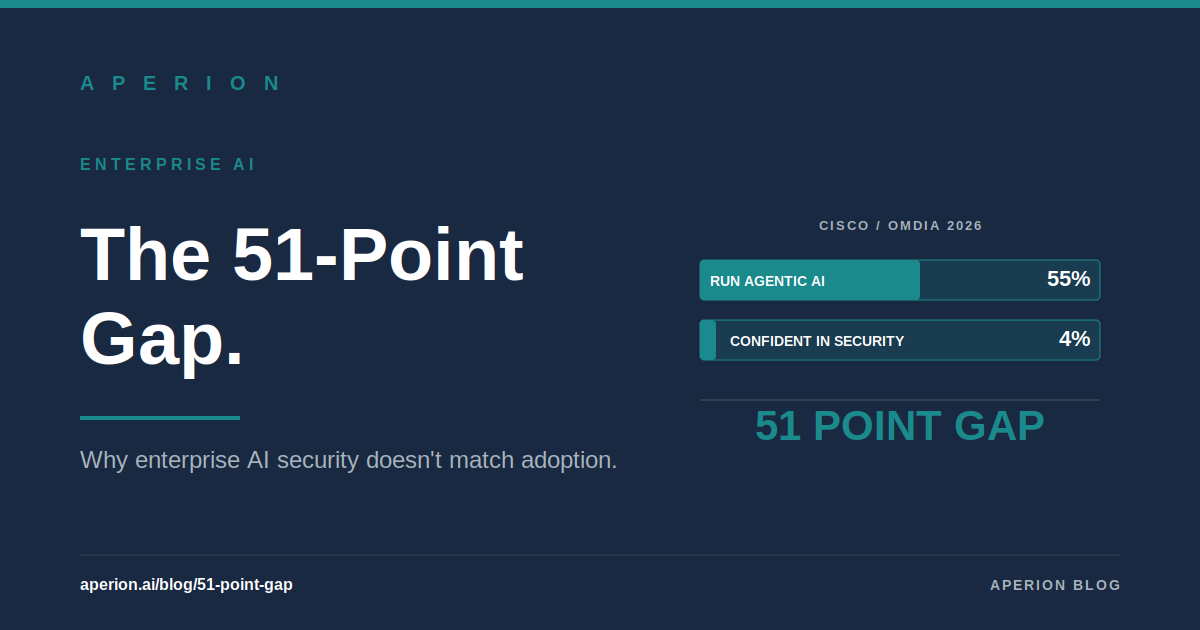
Cisco and Omdia published joint enterprise AI survey results in early 2026.
Two numbers from that survey:
55% of enterprises are running agentic AI in some form.
4% of enterprises are confident in their AI security posture.
The 51-point gap between adoption and confidence is the most important market signal in enterprise AI right now. This post explains why the gap exists, why it has not closed even as security products have proliferated, and what the architecture for closing it looks like.
What 4% confidence actually means
When a CISO says they are not confident in their AI security posture, the statement is technically precise. It does not mean the CISO has done nothing. It means the CISO has identified specific controls they cannot currently provide and specific evidence they cannot currently produce.
The controls a confident CISO would want to be able to point to:
Identity verification at the source. Every AI agent’s authority chain traces back to a verified human principal, with verification at NIST IAL2/AAL2 strength. Account-level credentials that can be phished or fabricated by a state-sponsored remote worker pipeline are not sufficient.
Inline policy at the data path boundary. Every prompt sent to a foundation model is inspected before transmission. Sensitive data is redacted by classification, not by hope. Data loss prevention rules apply at the protocol layer, not at the application layer where they can be bypassed by alternative protocol routing.
Per-call identity attribution. Every model interaction is logged with attribution to the verified human principal who authorized the agent that made the call. Not session-level attribution. Per-call.
Cryptographic audit trail. The audit log is tamper-evident by cryptographic chain, with trusted timestamps, retained in WORM storage. A regulator examining the audit cannot be told to trust the operator’s word about what the log contains; the log proves itself.
Inter-agent authentication. When agent A calls agent B, the call carries cryptographic proof of authorization back to the original human principal. Multi-agent workflows do not bypass identity controls.
Tamper-evident regulatory evidence packages. SR 11-7, FINRA 3110, FFIEC, EU AI Act, HIPAA evidence is producible on demand, complete, current, and defensible.
A CISO who can produce all of these is confident. A CISO who can produce some of them and not others reports low confidence because the gaps are the parts that matter in an examination.
The 4% figure means almost no enterprise can produce all of these today. The 55% figure means most enterprises have deployed agentic AI anyway.
Why workflow governance does not close the gap
Microsoft Agent 365 went GA on May 1, 2026. ServiceNow Action Fabric went GA on May 5, 2026. Both products provide workflow-level governance over AI agents. Both products will be deployed at significant scale by the end of 2026.
Workflow governance is necessary. It does not close the 51-point gap.
The reason: workflow governance addresses agent sprawl, agent registry, agent permissions, and agent workflow integrity. These are CIO problems. They are real. They produce real value when solved.
What workflow governance does not address: inline policy at the data path boundary. The workflow platform sits above the call between the agent and the model. It does not sit in that call. When the agent sends a prompt that contains PII to a public foundation model, the workflow platform records that the agent took an action. The workflow platform does not redact the PII before transmission. The data has already left the network perimeter by the time the workflow layer logs it.
A CISO concerned about regulatory exposure on the data exfiltration question cannot answer that question by deploying workflow governance. The CISO needs a separate product, at a different architectural layer, sitting in the call path. The 51-point gap is largely the absence of that separate product in most enterprise deployments.
Why identity governance alone does not close the gap
The agent identity layer is consolidating fast. Veza, SailPoint, Okta, Microsoft Entra are all moving toward agent identity products. Cisco bought Astrix for non-human identity. The category will see continued investment.
Identity governance is also necessary. It also does not close the 51-point gap by itself.
The reason: identity governance establishes who the agent is and what the agent is authorized to do. Identity governance does not inspect what the agent actually sends to the model. A verified agent with valid authority can still send sensitive data to a foundation model that should not receive it.
The agent identity layer answers the question “who is acting.” The data path layer answers the question “what did they send.” Both questions need answers. Most enterprise deployments today have partial answers to the first question and almost no answer to the second.
The 51-point gap is dominated by the second question.
Why data governance does not close the gap
Oracle, Snowflake, Databricks, and the broader data governance category address where the data sits and who can access it. These products are mature, well-deployed, and effective at their scope.
Their scope does not include the prompt-response transaction between an agent and a foundation model. Data governance products evaluate access to datasets. The prompt-response transaction is not a dataset access; it is an outbound communication carrying data that was previously authorized for the agent but is now being transmitted to an external endpoint.
A data governance product can prevent an agent from reading a sensitive dataset. It cannot prevent an agent that legitimately accessed a dataset from including content from that dataset in a prompt to a public model. The data is already in the agent’s working memory by the time the prompt is constructed. Data governance does not extend to outbound traffic inspection.
The 51-point gap requires controls at the prompt-response transaction layer.
What does close the gap
Runtime governance, as a distinct architectural layer, is what closes the gap.
The product category is defined by the controls it provides:
Inline at the prompt-response boundary. The product sits in the call path between the agent and the model. Every prompt is inspected before transmission. Every response is inspected before return.
Policy enforcement, not just observation. The product can redact, block, classify, and rewrite. It is not a passive logging layer; it is an active policy enforcement point.
Identity-bound logging. Every call is logged with attribution to the verified human principal in Layer 1 of the Trust Fabric. The audit trail is identity-attributed at the call level, not at the session level.
On-premises or sovereign cloud deployment. For regulated industries, the product runs on operator-controlled infrastructure. Data does not transit a third-party cloud as part of the inspection.
MCP tool call governance. As agents move from chat-only patterns to tool-use patterns, the tool call boundary is the new policy enforcement point. The product governs not just the model call but also the tool calls the agent makes against MCP servers.
Tamper-evident audit output. The logs are cryptographically chained, timestamped against trusted time services, and stored in WORM media. The audit defends itself in examination.
This is the SmartFlow product category. APERION is the company at this layer. The Trust Fabric is the broader architecture that combines this layer with identity proofing (Layer 1), access governance (Layer 2), and audit and evidence (Layer 4).
The procurement signal
The 51-point gap is approximately the addressable runtime governance market.
Each enterprise in the 51% will eventually procure runtime governance because the procurement signal will arrive in one of three forms:
Regulatory action. A supervisor cites the operator for failing to produce evidence the regulator expected. The operator scrambles to find a vendor that can produce the missing evidence. Procurement happens fast and at higher cost than deliberate procurement would have been.
Incident response. The operator suffers a data exfiltration to a foundation model, discovers it in a security review, and identifies that runtime controls would have prevented it. Procurement happens after the incident, often as part of an incident response package.
Board pressure. The board reads the same surveys the CISO read. The board asks the CISO what the enterprise is doing about the 4% confidence number. The CISO produces a roadmap. The roadmap requires procurement.
The 51% will arrive at procurement through one of these three paths. The percentage of enterprises that complete deliberate procurement before either regulatory action or incident response forces them into reactive procurement is the procurement window for the category.
For regulated enterprises specifically, the EU AI Act’s August 2026 effective date plus the Five Eyes joint advisory creates a regulatory baseline that will accelerate this procurement cycle. The window for deliberate procurement is narrowing as the regulatory and incident-driven signals arrive in 2026 and 2027.
What good looks like
A CISO who has closed the 51-point gap can answer the following questions affirmatively, without hedging:
- Can you produce a complete audit of every prompt sent from an authorized agent to a foundation model in the last 90 days, with identity attribution at the call level?
- Can you demonstrate that PII categorized as protected under HIPAA was not transmitted in any prompt to a public foundation model in the audit window?
- Can you show the supervisory authority a sample of the audit log and have them verify its integrity without trusting your word?
- Can you identify every MCP tool the agents invoked and prove each tool’s identity, provenance, and authorization?
- Can you produce SR 11-7 or FINRA 3110 or EU AI Act evidence on demand without a separate compliance project?
These are concrete questions. They have concrete answers under runtime governance. They do not have answers under workflow governance, identity governance, or data governance in isolation.
The 51-point gap is closeable. The architecture exists. The procurement window is open.
Technical companion: SmartFlow for Regulated Industries. How SmartFlow’s runtime governance addresses SR 11-7, FINRA 3110, FFIEC, and EU AI Act requirements.
The performance characteristics: SmartFlow Performance Whitepaper. Sub-five-millisecond Rust gateway overhead, 3.2x faster than direct OpenAI at 40 RPS with semantic caching.
The architecture: Trust Fabric. Four layers, two distinct planes.

Ready to govern your AI infrastructure?
See how SmartFlow gives regulated industries complete AI sovereignty.
Request a Demo View Documentation