AI Governance Is Now a Board Mandate. Execution Is Still Missing.
Fortune 500 boards are demanding AI governance. Only 14% of their companies can deliver it. The gap is operational, not strategic.

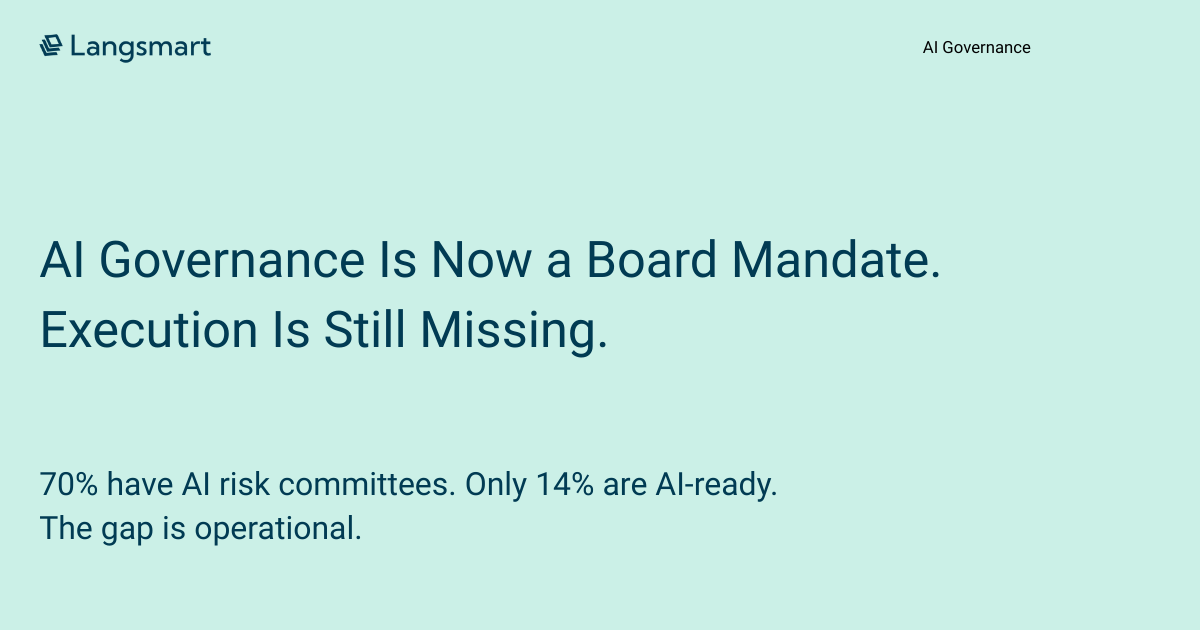
A Fortune report from December 2025, citing Sedgwick's 2026 forecasting data, reveals a striking disconnect in enterprise AI readiness. Seventy percent of Fortune 500 executives say their companies have AI risk committees. Sixty-seven percent report progress on AI infrastructure. Forty-one percent have a dedicated AI governance team.
But only 14 percent say they are fully ready for AI deployment.
The gap between governance structure and governance capability has become the defining challenge of enterprise AI adoption. Boards are mandating oversight. Committees are meeting. Teams are being hired. But the operational foundations — the processes, controls, tooling, and skills needed to make governance real in daily operations — have not kept pace.
At the Fortune Brainstorm AI event in San Francisco, Navrina Singh of Credo AI identified the three specific gaps that explain this disconnect. The first is visibility: most organizations still lack a comprehensive view of where AI is used across the business. Shadow AI tools proliferate while sanctioned projects go uncatalogued. Without a map of AI systems and use cases, governance bodies are managing risk they cannot see.
The second gap is conceptual: governance is not the same as regulation. Treating governance as a compliance checkbox leaves major gaps in how AI actually behaves in production. Governance includes understanding risk, proving product quality, ensuring reliability, and maintaining alignment with organizational values.
The third is literacy: you cannot govern something you do not use or understand. When only a small AI team grasps the technology while the rest of the organization deploys AI-enabled tools, governance frameworks do not translate into responsible decisions.
These gaps share a common thread. They are not solved by committee structures, policy documents, or organizational charts. They are solved by infrastructure that provides automated visibility into AI usage, enforces governance policies in real time without requiring human intervention, and produces audit evidence that proves compliance to boards, regulators, and auditors.
The 86 percent of Fortune 500 companies that are not fully ready for AI deployment are not lacking strategy. They are lacking the operational infrastructure to execute it.