
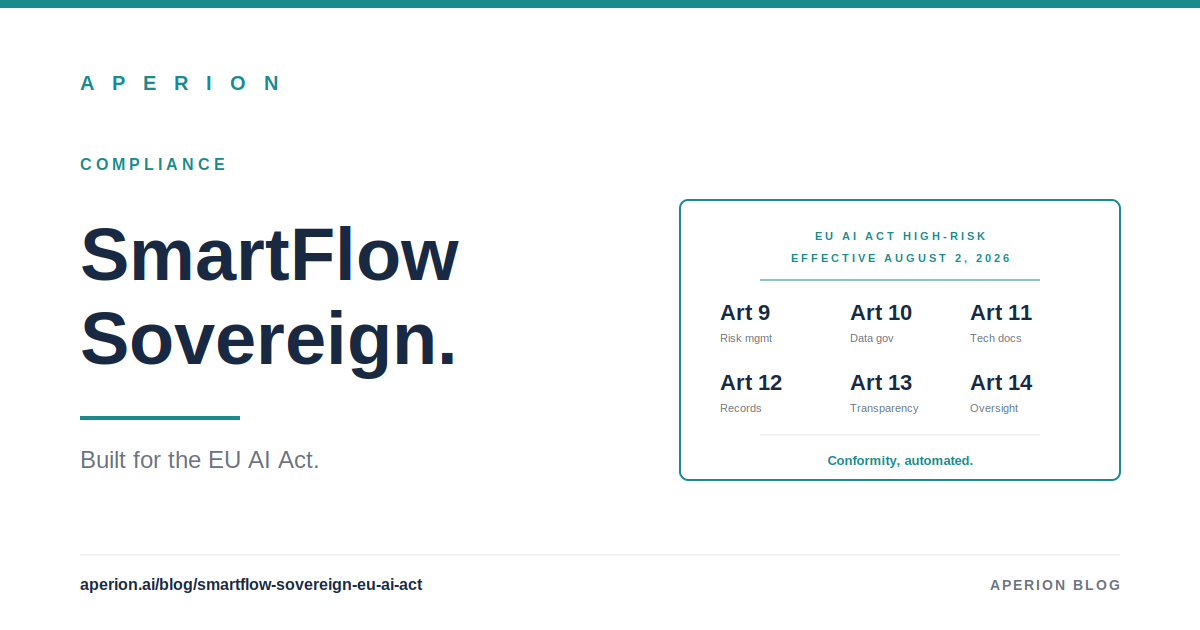
The EU AI Act’s high-risk system provisions take effect August 2, 2026.
The provisions impose specific obligations on AI systems used in employment, education, critical infrastructure, law enforcement, migration, and justice. The obligations are detailed, prescriptive, and enforced by national supervisory authorities backed by penalties that can reach 7% of global annual turnover.
Most AI infrastructure deployed in regulated EU operations today can produce some of the evidence the Act requires. The risk frameworks describe the categories. The compliance documentation covers parts of the obligations. The audit logs cover other parts.
What does not exist in most deployments is the integrated, article-by-article, continuous compliance posture that the Act assumes the operator can produce on demand. Most operators today would need months of staff effort to assemble the conformity evidence for a single high-risk system if a regulator showed up tomorrow.
SmartFlow Sovereign, released as SmartFlow 1.8 in April 2026, is built for the Act. This post explains what the Act actually requires and how Sovereign produces the required evidence by default.
What the Act requires, article by article
The high-risk system obligations span Articles 9 through 15 of the EU AI Act. Each article is a specific control.
Article 9: Risk management system. The operator must implement and document a continuous risk management process across the AI system’s lifecycle. Identify foreseeable risks. Estimate them. Evaluate emerging risks. Adopt mitigation measures.
The evidence the Act expects: a documented risk management process, with versioned outputs, attached to the specific high-risk system, updated continuously, and presentable to a supervisor.
Article 10: Data and data governance. Training, validation, and test data sets must meet quality criteria. The data must be relevant, representative, accurate, complete. Data governance must include design choices, data collection processes, annotation labelling cleaning, augmentation, and detection of biases.
The evidence the Act expects: data lineage from collection to deployment, with documented governance decisions at each step.
Article 11: Technical documentation. Comprehensive technical documentation must be drawn up before the system is placed on the market and kept up to date. Annex IV specifies the contents in detail: system description, design specifications, training data summaries, performance metrics, intended purpose, and more.
The evidence the Act expects: a complete technical file matching Annex IV’s specification, available for inspection on demand.
Article 12: Record keeping. High-risk systems must automatically generate logs of operations enabling traceability of the system’s functioning across its lifecycle. Logs must be kept for a period appropriate to the intended purpose, with traceability guaranteed across the system lifecycle.
The evidence the Act expects: tamper-evident, time-stamped logs of system operation, retained for a defined period, recoverable on demand.
Article 13: Transparency. The system’s operation must be sufficiently transparent that deployers can interpret outputs and use them appropriately. The provider must supply instructions for use and information on system characteristics, capabilities, and performance limitations.
The evidence the Act expects: documented system characteristics, performance bounds, and operational guidance accessible to deployers.
Article 14: Human oversight. The system must be designed and developed to be effectively overseen by humans during the period in which it is in use. Oversight must enable understanding of the system’s capacities and limitations, awareness of automation bias, ability to interpret outputs, ability to disregard or reverse decisions, and ability to intervene or interrupt.
The evidence the Act expects: oversight mechanisms by design, with auditable evidence of human review at risk-significant decision points.
Article 15: Accuracy, robustness, and cybersecurity.Appropriate level of accuracy, robustness, and cybersecurity for the intended purpose. The system must perform consistently throughout its lifecycle. Resilience to errors, faults, and inconsistencies. Cybersecurity measures appropriate to risk.
The evidence the Act expects: documented performance metrics, robustness testing results, and cybersecurity controls aligned to risk level.
Seven articles. Each one a specific control. Each control requires its own evidence. The challenge for any operator is that the evidence has to be produced as a coherent set, attached to a specific deployed system, current as of the supervisor’s request, and defensible in a conformity assessment.
Most existing AI infrastructure does not produce evidence in this shape. The operator has to assemble the evidence retroactively from disparate sources. By the time a regulator asks, the assembly takes weeks and the answers are partial.
What SmartFlow Sovereign produces
Sovereign was built so that an operator deploying a high-risk AI system in EU operations can present complete, current conformity evidence on demand. The architecture produces the artifacts the Act requires as a side effect of system operation, not as a separate compliance project.
Conformity Console. Article-by-article evidence dashboard. Each article maps to its required evidence. Each evidence requirement maps to the SmartFlow capability that produces it. Each capability produces continuous evidence, not point-in-time snapshots. The conformity posture is current as of the moment the supervisor or auditor opens the console.
WORM-immutable audit archive. Article 12 record keeping. Logs are written to write-once, read-many storage at the storage layer, not at the application layer. Supported backends include S3 Object Lock, Azure Immutable Blob, GCS Bucket Lock, and NetApp SnapLock. The immutability is enforced by the storage backend’s compliance mode, not by application logic that an attacker could subvert.
RFC 3161 trusted timestamps. Every audit event is timestamped against an eIDAS-grade trusted time service, anchored to a public root of trust. The timestamp is verifiable by any third-party auditor without trusting APERION or SmartFlow. The timestamp survives an attacker who compromises the operator’s clock infrastructure because the validation references a cryptographic root, not local time.
Signed AI Bill of Materials. Annex IV technical documentation. The AI-BOM lists the model versions, weights provenance, training data attestations, hyperparameters, evaluation metrics, and deployment configuration. The BOM is signed with Sigstore and Cosign, providing cryptographic provenance for the technical file.
MCP Trust Registry. Every Model Context Protocol server connected to the system is bound to a verified identity, with SLSA provenance attestation and Sigstore signature verified at runtime. Article 15 cybersecurity requires controls on the system’s dependencies; the MCP Trust Registry produces evidence that every external tool the agent invoked was a verified, signed, attested artifact.
National AI Inventory. Article 79 incident notification. Member states require supervisor-grade inventories of high-risk AI systems operating in their jurisdiction. The National AI Inventory feature produces these inventories per-jurisdiction, suitable for direct submission to national supervisory authorities, with automatic incident pipeline for Article 73 serious incident reporting.
Pre-Bind Insurance Engine. AI deployment risk quantified in actuarial terms an underwriter can price. NAIC 275 conformance. IDD POG product oversight and governance. Regulation Best Interest. Sustainable Finance Disclosure Regulation. The first AI infrastructure that produces insurable risk metrics, enabling enterprises to bind AI deployment insurance pre-deployment instead of self-insuring post-incident.
Deployment topology for sovereign operation
The EU AI Act’s high-risk provisions interact with sovereign infrastructure requirements from member states. Some jurisdictions require data residency. Some require sovereign cloud deployment. Defense and critical infrastructure operators may require air-gapped or IL5-equivalent isolation.
Sovereign supports five deployment SKUs to address the spectrum:
- FedRAMP for U.S. federal civilian deployments
- IL5 for U.S. defense impact level 5
- GAIA-X compatible for EU sovereign cloud
- Air-gapped for high-security operational environments
- Sovereign cloud for member-state-specific data residency requirements
The architecture supports the same Sovereign capabilities across all five SKUs. The Conformity Console works identically whether the deployment is in a U.S. federal authorization boundary, an EU sovereign cloud, or an air-gapped facility. The audit archive uses the appropriate WORM backend for the deployment.
The economics of getting this wrong
EU AI Act penalties scale with global annual turnover, not with EU revenue. A U.S.-based enterprise with 5% of revenue in the EU faces penalties calculated against 100% of global turnover. The financial exposure for an enterprise with non-conforming high-risk AI deployments is material.
The penalty structure is tiered:
- Up to 7% of global annual turnover or €35 million for prohibited AI practices
- Up to 3% of global annual turnover or €15 million for non-compliance with most obligations including high-risk system requirements
- Up to 1.5% of global annual turnover or €7.5 million for incorrect, incomplete, or misleading information to authorities
The 3% tier is the relevant one for high-risk system obligations under Articles 9-15. For an enterprise with $50 billion in global turnover, the maximum penalty per non-conformance is $1.5 billion. The supervisory authorities are not expected to apply the maximum penalty in every case, but the structure exists and member states have signaled they will enforce it.
The cost of building Article-9-through-15 compliance retroactively, after a supervisor flags non-conformance, is also material. Estimates from the major consultancies put retroactive compliance at six to twelve months of dedicated effort per high-risk system. Sovereign produces the evidence as a property of system operation, not as a separate consulting engagement.
Who should evaluate Sovereign now
Three classes of operator face material exposure on the August 2, 2026 effective date and should evaluate Sovereign immediately:
Financial services operators in EU markets. Credit scoring, insurance underwriting, and certain trading systems fall under high-risk classification. Tier 1 banks with EU operations have AI deployments at scale and limited time to retrofit compliance.
Healthcare operators in EU markets. Medical devices using AI for diagnosis or treatment recommendation are high-risk under both the EU AI Act and the Medical Device Regulation. The interaction between the two regimes creates additional documentation burden.
Critical infrastructure operators across all sectors. AI systems used in operation of critical infrastructure are high-risk. Energy, water, transport, and telecommunications operators with AI deployments in EU jurisdictions need to be conforming on day one.
For each class, the question is not whether the obligations apply but whether the operator can produce the evidence the obligations require. Sovereign is built to make the answer yes.
Technical companion: SmartFlow 1.8 Sovereign release notes. Full feature reference for the Conformity Console, WORM archive, RFC 3161 timestamps, signed AI-BOM, MCP Trust Registry, National AI Inventory, and Pre-Bind Insurance Engine.
Sample regulatory examination reports: SR 11-7, FINRA 3110, EU AI Act sample packages.
Trust Fabric Layer 4 (Audit and Evidence): Trust Fabric page. How Sovereign sits within the broader Trust Fabric architecture.

Ready to govern your AI infrastructure?
See how SmartFlow gives regulated industries complete AI sovereignty.
Request a Demo View Documentation